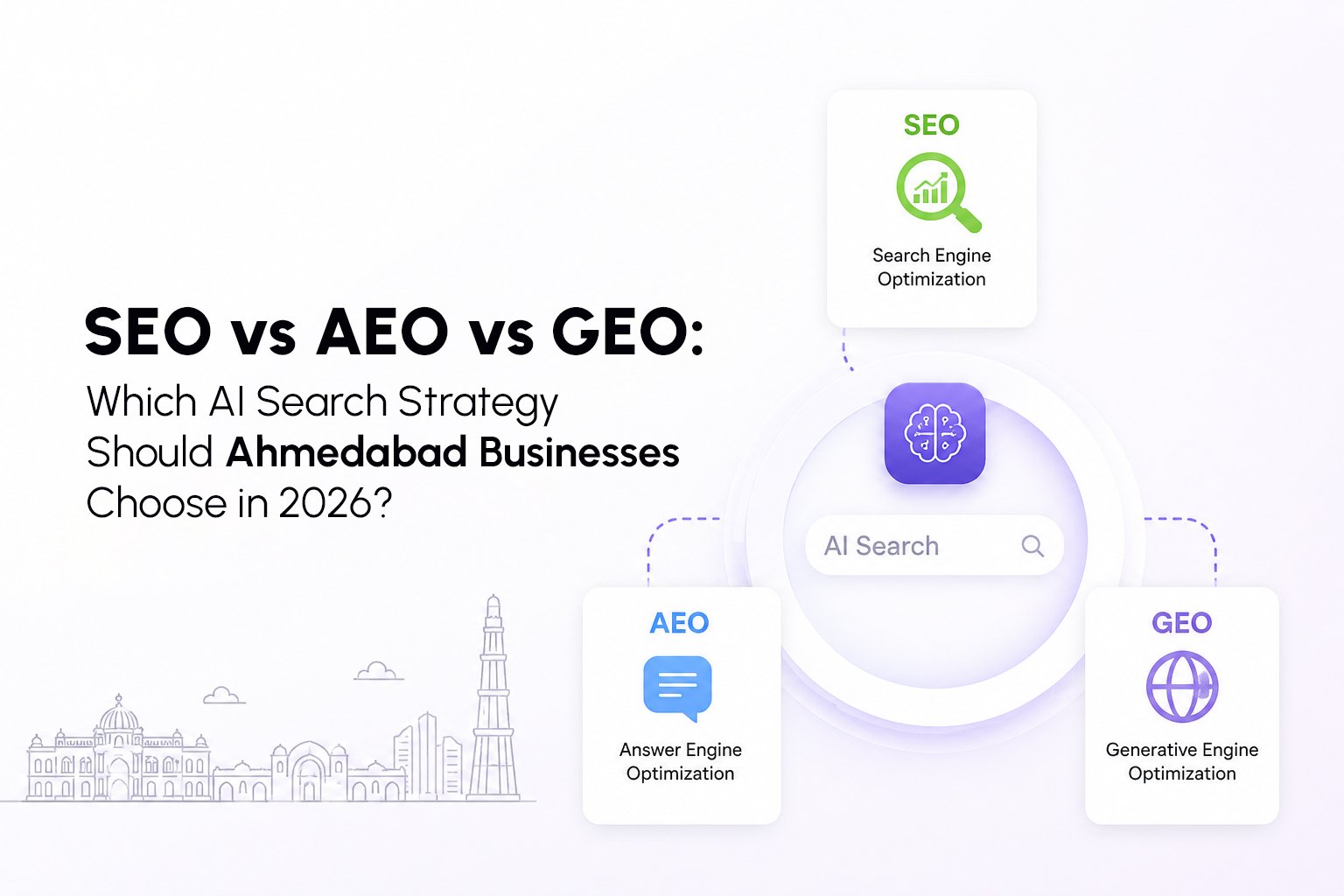
Quick answer: Ahmedabad businesses should adopt SEO, AEO and GEO together, because they are three layers of the same visibility stack, not competing strategies. SEO gets your site found on Google, AEO wins featured snippets and voice answers, and GEO gets your brand cited in ChatGPT, Perplexity, Gemini and AI Overviews. The right weighting depends on your industry.
Quick Answer: While many businesses compare AEO vs SEO, the reality is that SEO, AEO and GEO are not three competing strategies. They are simply three layers of the same visibility stack. SEO helps your website get found on Google. AEO gets your answers picked for voice assistants and featured snippets. GEO helps your brand get cited in ChatGPT, Perplexity, Copilot and Google AI Overviews. Ahmedabad-based businesses that want to stay visible as search evolves in 2026 need all three working together, with the right balance based on their industry and buyer journey.
Key Takeaways
- SEO, AEO and GEO solve different parts of the buying journey
- AI Overviews now answer most queries before a click ever happens
- Manufacturers and D2C brands need different weighting of each strategy
- Structured content and clear entities matter more than keyword density
- Combining all three is now the baseline, not the exception
The Problem Every Ahmedabad Business Owner Is Quietly Facing
Last month, I spoke with a Naroda based textile manufacturer who shared a common concern. His website was already ranking on the first page for “cotton fabric manufacturer Ahmedabad” but website traffic was almost the same for months and the number of inquiries started declining.
At first, it didn’t seem like an SEO problem. His website was still being found in search results, according to Google Search Console. But there was a catch. Many users were getting the information they needed from Google’s AI Overview, so they never scrolled down to click on his website. His rankings were still good, but they weren’t bringing the same business results anymore.
That’s the shift happening across nearly every industry right now, from CA firms in Navrangpura to D2C skincare brands shipping out of Bopal. Search hasn’t disappeared. It’s just splitting into multiple destinations like Google’s organic results, AI Overviews, ChatGPT, Perplexity, Gemini and each one rewards a slightly different kind of content.
Why Search Behavior Changed So Fast
Google’s own Search Quality Systems documentation confirms what most marketers already sensed: the company has been layering AI-generated summaries directly into results pages, reducing the number of queries that end in a traditional click. Bing built a similar model into Copilot. OpenAI’s ChatGPT search and Perplexity built theirs from scratch, pulling live web data to answer questions conversationally instead of listing ten blue links.
For a business owner, the practical result looks like this: fewer people are typing a query, scanning ten results and clicking through. A growing share are asking a question once and getting a synthesized answer which is like sometimes with your competitor’s brand mentioned, sometimes with yours, sometimes with neither. This is the gap that SEO alone can no longer fill.
What SEO Actually Means in 2026 (Not the 2015 Version)
Backlinks, keyword density and meta tags were the old days of search engine optimization. That iteration of SEO is pretty much dead. And what remains is the core discipline: making sure your site is technically sound, structurally clear and truly useful enough that Google trusts you as a source.
Google’s Quality Rater Guidelines still link it all to Experience, Expertise, Authoritativeness and Trust. A local dentist’s website that features real before and after cases, a verified Google Business Profile and genuine reviews from patients will always rank higher than a generic template site that has the words “best dentist in Ahmedabad” fifteen times on each page.
SEO today is much more than just keywords and clever copy. Today, it helps establish your credibility online. When search engines consistently understand and trust your website, AI platforms are far more likely to reference your content. That’s why SEO remains the starting point for both AEO and GEO.
What AEO (Answer Engine Optimization) Actually Involves
AEO is the practice of structuring content so it gets selected as the answer inside featured snippets, voice search results and the “People Also Ask” boxes.
Here’s what that looks like in practice. A local café owner in Satellite wanted to rank for “best filter coffee near me.” Ranking on page one wasn’t enough; the goal was owning the answer box. That meant restructuring the FAQ section with direct, self-contained answers (each under 40 words), using schema markup and answering the exact phrasing customers search for, not marketing language.
AEO rewards clarity over cleverness. It punishes buried answers. If your main point sits in paragraph twelve, an answer engine will skip your page entirely and pull from a competitor who put it in paragraph one.
What GEO (Generative Engine Optimization) Actually Involves
GEO – Generative engine optimization is the newest layer and it’s the one most Ahmedabad businesses haven’t touched yet. It focuses specifically on getting cited or referenced inside generative AI tools like ChatGPT, Claude, Gemini and Perplexity that is when someone asks a broader, conversational question.
Unlike traditional search, these tools don’t rank ten pages. They synthesize an answer from a handful of sources and often name only two or three brands by name. Getting into that shortlist depends less on backlinks and more on how clearly your content defines entities, states facts and structures comparisons.
One example: A SaaS company selling inventory software appeared in a ChatGPT response to “best inventory tools for small manufacturers in India” not because of paid ads but because their comparison page was easy to summarize and had clear pricing tiers, use cases and limitations in a format the model could easily extract.
SEO vs AEO vs GEO: A Direct Comparison
| Factor | SEO | AEO | GEO |
| Primary goal | Rank on Google’s organic results | Win featured snippets & voice answers | Get cited inside AI-generated answers |
| Main platforms | Google, Bing organic search | Google featured snippets, Alexa, Siri | ChatGPT, Perplexity, Gemini, Google AI Overviews |
| Content style | Keyword-optimized, link-worthy pages | Direct, self-contained answers | Entity-rich, well-structured explanations |
| Success signal | Rankings, organic traffic | Snippet ownership, voice answer share | Brand mentions/citations in AI responses |
| Technical need | Site speed, backlinks, on-page SEO | Schema markup, FAQ formatting | Clear data, structured tables, factual accuracy |
| Time horizon | Medium to long term | Short to medium term | Medium term, still evolving |
None of these replace the others. A page that ranks well on Google but reads like a wall of unstructured text will lose the AEO and GEO opportunity entirely.
What an “AI Search Strategy” Actually Looks Like for a Real Business
An AI search strategy isn’t a separate marketing plan bolted onto your existing website. It’s a rework of how content gets structured so it performs across all three layers at once.
Take a real estate company selling in GIFT City. Their old blog post on “documents required for property purchase in Gujarat” was 1,200 words of dense prose. Rewriting it with a direct-answer opening, a numbered checklist and a comparison table for resale versus new construction didn’t just improve rankings, it started showing up as a cited source inside Perplexity answers within eight weeks, based on referral traffic patterns visible in their analytics.
That’s the pattern worth noticing: structure drives citation. Not volume, not keyword count.
Which Strategy Fits Which Type of Ahmedabad Business
- Manufacturers (textile, chemical, engineering)
Buyers research manufacturers through long, multi-touch journeys like RFQs, comparisons, technical specs. GEO matters here because procurement teams increasingly ask AI tools to shortlist suppliers before ever visiting a website. Detailed capability pages with clear specs outperform generic “About Us” copy. - D2C brands (skincare, fashion, food)
This is where SEO and AEO carry the most weight, alongside strong D2C social media strategies that drive branded search volume. Product pages need FAQ blocks answering ingredient questions, shipping policies and comparison queries which is the exact phrasing a snippet or voice assistant would surface. - Local services (dentists, salons, gyms, cafés)
Google Business Profile optimization and AEO dominate here. Most queries are hyperlocal (“near me,” “open now”) and voice search share is highest in this category. - CA firms, legal and professional services
Trust signals matter more than volume. A single, well-researched guide that explains tax regulations, outlines compliance deadlines and clearly identifies the author carries far more authority than dozens of shallow articles. That’s the kind of content both Google and AI search systems prefer to reference. - SaaS companies
Comparison content is everything. GEO-optimized pages that clearly define pricing, features and limitations get pulled into AI answers about “best tools for X.” This is also where strong content marketing services pay off long term. - Health care facilities and hospitals
Accuracy and author credentials are not up for debate. Google has stricter E-E-A-T requirements for health content (a “Your Money or Your Life” topic), so medically reviewed and clearly attributed content is a must for all three strategies. - Education institutes
FAQ-heavy AEO content that answers admission, fee and eligibility questions performs well, along with SEO-driven local landing pages for each course or program.
Common Mistakes Businesses Make with This Shift
Most businesses make one of three mistakes. Many businesses focus GEO without fixing basic SEO foundations first but remember no AI tool cites a slow, unindexed, technically broken site. Others spend too much time formatting content for featured snippets but forget to keep their answers clear, accurate and up to date. Then there are businesses that continue publishing large amounts of old-style content, expecting quantity alone to bring results.
The businesses seeing better results are the ones that plan their website properly, not that treating it as something to fix later.
How AI Engines Actually Retrieve Information
Google AI Overviews pull from indexed, high-quality pages that already ranking well organically, layering a synthesized summary on top. Perplexity and the search feature in chatgpt work differently, essentially crawling live web results at query time, favoring pages with clear structure, recent dates and verifiable facts. Gemini is baked into Google’s ecosystem, so it heavily leverages Search Console signals and structured data.
All four platforms share one commonality like they favour content that’s easy to read and understand. People and AI can find information with short paragraphs, clear headings, comparison tables and direct answers. Research from Search Engine Land and Search Engine Journal also shows that AI-generated answers are often include well-structured, trustworthy content than lengthy pages content with zero real structure.
A Practical Framework to Combine All Three
- Start with SEO fundamentals. Fast site, clean architecture, solid on-page optimization. Nothing else works without this base.
- Layer in AEO. Add direct-answer boxes, FAQ schema and concise responses to the exact questions your customer type.
- Build for GEO last. Add comparison tables, clearly defined entities and factual depth that AI models can extract and summarize accurately.
- Support it with distribution. Strong social media management services and performance marketing services build the brand signals and search volume that make AI systems more likely to recognize and trust your name.
- Review quarterly. AI search behavior is still shifting fast enough that a strategy built in January may need adjusting by June.
If you’re unsure where your business stands today, Neoma Media can help you evaluate your current SEO, AEO and GEO performance. A simple content and technical audit often reveals opportunities that traditional SEO reports miss.
Actionable Checklist for 2026
- Audit your top 10 pages for direct-answer clarity in the first 100 words
- Add FAQ schema to at least your five highest-traffic pages
- Build one comparison table per core product or service category
- Verify your Google Business Profile is fully complete and active
- Check whether ChatGPT and Perplexity currently mention your brand at all
- Update outdated statistics and dates across older blog content
- Ensure every page has a clear, named author with credentials
Where This Leaves You
The businesses that will grow in 2026 won’t be the ones chasing every algorithm update. They’ll be the ones creating content that’s useful, trustworthy and easy for both people and AI search engines to understand. If you’re ready to build a future-ready search strategy, Neoma Media helps Ahmedabad businesses strengthen their visibility across Google Search, AI Overviews, ChatGPT, Claude, Gemini and Perplexity.
Frequently Asked Questions
Is GEO replacing SEO?
No. GEO depends on SEO fundamentals being solid first. Think of GEO as an additional layer, not a replacement.
Do small Ahmedabad businesses really need AEO and GEO or just SEO?
Local businesses with high “near me” search volume benefit most from AEO. Businesses selling higher-consideration products (SaaS, manufacturing, real estate) see faster GEO returns.
How long does GEO take to show results?
Most businesses see early citation activity within 6 to 10 weeks of restructuring content, though this varies by industry and existing domain authority.
Can one person handle SEO, AEO and GEO alone?
It’s possible for a small business, but most mid-sized companies pair a strong content foundation with dedicated content marketing services to keep pace with how quickly AI search behavior is changing.